


































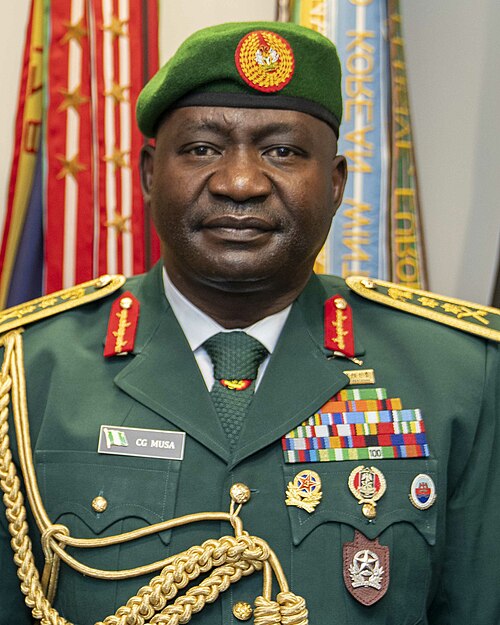
President Bola Ahmed Tinubu has put forward retired General Christopher Gwabin Musa as Nigeria’s next Minister of Defence, marking a significant shift in the country’s security leadership. The nomination, formally conveyed to Senate President Godswill Akpabio, follows the unexpected resignation of former Defence Minister Mohammed Badaru Abubakar, who stepped down earlier in the week.
General Musa, a respected military officer who served as Chief of Defence Staff from 2023 to October 2025, is widely regarded for his strategic approach to counter-insurgency operations. His tenure as Theatre Commander of Operation HADIN KAI in the North-East earned him national recognition for leading several successful campaigns against insurgent groups. In 2012, he received the prestigious Colin Powell Award for Soldiering, a testament to his leadership and dedication.
Born in Sokoto in 1967, Musa completed his primary and secondary education in the state before attending the College of Advanced Studies in Zaria. He enrolled at the Nigerian Defence Academy in 1986 and graduated in 1991 with a Bachelor of Science degree, beginning a military career that would span more than three decades.
His nomination comes at a time when Nigeria faces one of its most challenging security periods in recent years. Rising violence, kidnappings, and insurgent activities across several regions have heightened calls for stronger, more coordinated defence strategies. Analysts believe General Musa’s experience, particularly his familiarity with Nigeria’s complex security terrain, positions him as a pragmatic choice to lead the Defence Ministry at this critical juncture.
Supporters of the decision argue that returning a seasoned military professional to the role may inject much-needed discipline and urgency into Nigeria’s defence apparatus. Critics, however, note that the weight of public expectation will be immense, as Nigerians increasingly demand visible improvements in safety and national security.
If confirmed by the Senate, General Musa will assume leadership of the ministry at a time when confidence in the nation’s security institutions is wavering. The task before him will involve not only strengthening military operations, but also rebuilding public trust, enhancing inter-agency cooperation, and offering strategic direction for long-term stability.
As the nation awaits the Senate’s deliberation, the nomination signals President Tinubu’s intent to recalibrate the country’s security architecture with a seasoned, battle-tested leader at its helm.